5 maj 2025
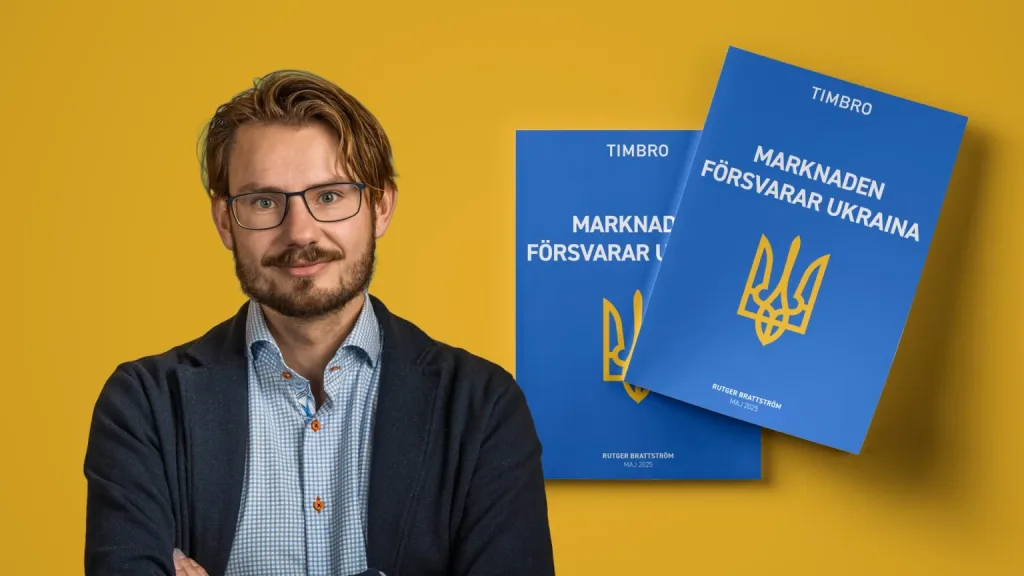
The market defends Ukraine
Rutger Brattströms report on the lessons Sweden can learn from Ukraines successful defense against Russia.
Introduction
Russia’s full-scale invasion of Ukraine in 2022 has forced radical changes in how Ukraine organizes its defense and defense industry. During the war, Ukrainian units have gained greater independence in both budget management and procurement of materiel. Simultaneously, close cooperation has developed between front-line brigades and the defense industry, resulting in rapid innovation and significantly increased domestic production capacity. These experiences are highly relevant for Sweden and other countries that will be rearming their defenses and preparing for modern warfare in the future. The report is based partly on open-source material and partly on oral sources from the report author’s visit to Kyiv in February 2025.
Independent Brigades
A notable feature of Ukraine’s defense organization during the war is that fighting brigades have been given direct control over certain budget funds for materiel purchases. Historically, procurement was centralized through the Ministry of Defense, which in peacetime meant long processes and sometimes bureaucratic obstacles. During the war, however, the need for speed and front-line decisions has taken over. The rapid technological development means that even countries in peacetime must adapt to avoid falling too far behind. As is well known, the war began in 2014, and has largely been fought by volunteer units. The supply of units has also largely been carried out by volunteer forces. In a chapter of the anthology ”Russian Warship, Go Fuck Yourself!”, Peter Lidén, lieutenant colonel and former defense attaché in Ukraine, writes that ”[t]he remarkable thing is the action of civil society. Throughout all the years since the war began, in addition to the volunteer units, much of the support and supply of the defense has been carried out by non-governmental organizations and other purely non-profit movements, i.e., by what is meant by civil society in Ukraine.” The brigades have learned to conduct their own fundraising and cooperate with civil society organizations to cover their own needs for equipment, supplies, and weapons. The decentralized procurement has proven to be so successful that Ukraine’s Ministry of Defense launched a pilot project in December 2024 where 2.1 billion hryvnia (about 50 million dollars) was allocated directly to fighting units for the purchase of drones. The pilot project was so successful that the system was made permanent and scaled up in January 2025. 2.5 billion hryvnia (about 60 million dollars) is now allocated monthly directly to Ukraine’s brigades specifically for drone procurement. These funds are distributed among all fighting brigades in the armed forces. Each brigade command can prioritize which drone types the money will be used for, based on what is deemed most effective for the brigade’s current tasks at the front. With the decision to distribute budget funds to the brigades, Ukrainian Defense Minister Rustem Umerov emphasized that the decentralized model is the most effective: ”We analyzed this experience and decided to scale up the initiative. Unit commanders will be able to use these funds to purchase exactly the drones that are most effective for performing their tasks at the front. This is another step towards creating the most flexible system for providing the military with everything needed to defend Ukraine.”
However, the brigades’ budgets are not solely determined by the allocations from the Ministry of Defense. The brigades have long established cooperation with civil society organizations that assist with everything imaginable. It is very difficult to determine what proportion of funding comes through this channel, as it involves thousands of organizations and over a hundred brigades cooperating crosswise. However, it is a considerable part of the Ukrainian defense that is financed this way. For example, Come Back Alive, one of the larger organizations, collected 260 million hryvnia during the period February 15–March 15, 2025. Ukrainian soldiers interviewed estimate that about half of the materiel used is purchased by the brigades themselves and half comes from the centralized systems.
Large parts of Ukraine’s defense procurement are of course carried out via the Ministry of Defense and its state-owned defense procurement companies, especially ammunition and weapons. But for things like drones, civilian vehicles, communications equipment, and clothing, the brigades have been highly active in procuring these themselves since the start of the war. Purchases can be made through procurement platforms or directly from manufacturers. Ukraine has digital procurement tools, such as the ProZorro system, which are used to conduct competitive procurements in a transparent manner. When individual brigades act as direct customers to defense producers, the process is simplest. A market for defense materiel has emerged – different brigades can choose different suppliers and solutions based on their experiences, which spurs suppliers to meet the actual needs of the units. Resource allocation becomes more dynamic; if a certain technology proves effective, the brigade can invest more of its budget in it, while less successful purchases can quickly be redirected to alternatives.
The need for fast and decentralized processes is something that is emphasized by Hans Thunander and Anton Holmström in the chapter ”Civil Drones in the War in Ukraine” in the Royal Swedish Academy of War Sciences’ anthology ”Drones / UAS – technology and capabilities” (2023). They write that ”[t]he importance of civilian drones had not been noted before the war, it became apparent only when Ukrainian civilian drone pilots streamed to Ukraine’s internal defense. The Ukrainian military forces have quickly and willingly adopted the civilian resources, which has been facilitated by a large freedom to act at the local and regional level in the country. Central control is limited, civilian resources can be utilized without time-consuming decision processes. […] What can we learn from this? In war, urgent needs arise that cannot be foreseen, but which can be met with civilian resources.”
In summary, the independent brigades have strengthened Ukraine’s defense through increased flexibility, faster procurement, and more needs-based resource allocation.
Defense Companies and Regulations
The close link between soldiers in the field and domestic defense companies has led to a rapid innovation cycle. Instead of new products being ordered and developed by the Ministry of Defense, as was the case before the war and is still the prevailing order in most defense forces, development and upgrades now take place in close dialogue with the front. Ukrainian soldiers test prototypes under actual combat conditions and provide immediate feedback to engineers and manufacturers. This rapid exchange of experience has become a decisive factor in developing better equipment at a high pace. Drone developers state in conversations that new models become outdated after about six months because the enemy has then learned to jam communications. Companies constantly need to update both hardware and software based on the opponent’s actions, something that would not have been possible without direct feedback loops from the front.
The close cooperation is reflected in defense companies selling directly to front-line units. Many Ukrainian units buy equipment directly from domestic producers or through the mediation of volunteer organizations, instead of waiting for state deliveries. This has created a functioning market economy: if a company can offer a demanded product quickly and reliably, word spreads among the units and more orders follow. Ukrainian drone companies like TAF Drones have grown explosively through front-line sales and now produce about 50,000 FPV drones per month.
However, it is not just about individual companies. In Ukraine, there are thousands of different innovation projects in the defense industry that are simultaneously working on various products that are tested on the front line. Nearly 3,000 different innovation projects in the defense industry have been registered with the Ukrainian innovation authority BRAVE1, and these are from more than 1,200 different manufacturers. Most will fail, but some will survive the competition and shape the future battlefield.
Many Ukrainian defense entrepreneurs state that their products have been developed in a similar way. It all starts with a personal contact at a specific brigade. The entrepreneur has an idea and discusses it with the soldiers on the front line. Soon, a prototype is delivered for field testing. The brigade provides feedback and they iterate their way to a functioning product, or abandon the project. At no point in the development process does the entrepreneur need contact with the military’s central command or other officials. NATO certification is obtained afterwards, when production is already underway.
The certification process is something that Ukrainian politicians and officials have worked hard to streamline. Before 2022, certification took one to two years, now it takes between two weeks and three months. The market-based approach has meant that production has scaled up in line with the demand for various products. The Ukrainian defense industry’s production volume is now more than 20 times larger than before Russia’s full-scale invasion. Before 2024, President Zelenskyy set a goal of producing one million drones. By the end of the year, the annual production rate was over four million. According to the country’s commander-in-chief, two-thirds of Russian losses are now inflicted by drones produced in Ukraine.
It’s not just about drones. Between 2023 and 2024, the production of artillery systems tripled, the production of armored vehicles increased fivefold, and ammunition production increased by 150 percent. Purchases of these goods are usually made through one of the two state-owned Ukrainian companies that handle the defense’s regular materiel procurement.
International aid to Ukraine is now probably most effectively provided in accordance with the so-called ”Danish model,” which has meant that Denmark, Sweden, and Iceland have directly financed arms production in Ukraine. The Ukrainian Ministry of Defense states that the Danish model means faster delivery times, better prices, and better opportunities to train with and maintain the materiel compared to buying foreign goods.
The continuous dialogue between users and manufacturers has also given rise to entirely new types of defense materiel. An example is the Ukrainian-developed naval drones that have rendered the Russian Black Sea Fleet obsolete. These surface drones were developed in record time through civil-military cooperation and now play an important role in naval combat capability. As a result of, among other things, the decentralized system, Ukraine has been ahead of Russia in technology development, especially when it comes to drones. However, the Russian side has begun to copy Ukrainian approaches and is therefore not far behind. Sweden and other countries that risk being drawn into conflicts with Russia in the future can expect to face an enemy whose pace of innovation is very rapid.
Despite the successes, the Ukrainian defense industry still faces challenges. During the war, the Ukrainian state has severely restricted arms exports, the idea being that the weapons are needed in the country. But in many cases, the production capacity of arms producers is now greater than the military’s budget. At the same time, Europe is rearming its defenses and is far behind in technology development, especially concerning various types of drones, electronic warfare, and command and control systems. Defense producers in Ukraine state that defense forces around the world are queuing up to buy their products, but trade barriers stand in the way of exports. When BRAVE1 surveyed the biggest problems of Ukrainian arms producers in the autumn of 2024, export restrictions were the answer. Russian missile attacks came only in second place. Most companies are considering, or have already started, moving production abroad to be able to export from there.
What does it look like in Sweden?
Sweden’s current defense organization and industry differ in many ways from Ukraine’s, not least because Sweden is at peace and has long had a more centralized planning process. However, Ukraine had a similar centralized system just three years ago, although civil society already bore a large part of the burden, politics had not adapted. The Public Procurement in the Defence and Security Areas Act (LUFS) gives the Swedish Armed Forces the possibility to make direct procurements where special security and supply needs exist and the cost is below 1.2 million SEK. This is a higher amount than the 700,000 SEK that applies to other state authorities, municipalities, regions, and other public actors falling under the Public Procurement Act (LOU). For the very largest investments and procurements within the defense, a decision or approval from the government is required. According to the Swedish Armed Forces’ appropriation direction, materiel investments exceeding 200 million SEK must be submitted to the government for approval.
Although the Swedish Armed Forces have slightly greater powers than the rest of the public sector, this does not mean that it is more decentralized. The Swedish Armed Forces often sign framework agreements that purchasers and officers are forced to use. Only the Swedish Armed Forces Logistics (FMLOG) and the Headquarters have the right to sign framework agreements. In addition, there are internal financial regulations with lower monetary limits for unit commanders’ purchases without further approval, to maintain control. Larger orders at the unit level are usually moved up to FMLOG.
Although the units have the possibility to make certain smaller local purchases, they do not have the possibility to prioritize when it comes to price, quality, delivery reliability, and other factors. The centralized framework agreements eliminate market mechanisms.
Since 2019, the Swedish Armed Forces have had the possibility to make purchases on their own, but the majority of procurements are made by the Swedish Defence Materiel Administration (FMV), which is a separate authority. At the end of 2024 and the beginning of 2025, FMV delivered drone systems to the Swedish Air Force and signed an agreement on the future delivery of autonomous underwater vehicles to the Navy. Let’s examine these procurements in more detail as speed is of the essence when purchasing these weapon systems.
Case study UAV 06 A FMV was commissioned to procure a drone system for the Army and Home Guard in October 2020. FMV completed its production plan in October 2021. It would take more than a year, until November 2022, before a design decision could be made. The decision was then made to purchase an existing model, the Parrot ANAFI USA GOV, which should have shortened the process somewhat. In March 2023, the technical documentation was established. One year and nine months later, at the turn of the year 2024–2025, the drone system, known as UAV 06 A in Swedish nomenclature, was delivered to the Army and Home Guard. The entire process took four years and two months.
Case study AUV MCM portable
The first design decision for the AUV MCM portable, an autonomous vehicle that can map the seabed and detect objects, was made in January 2024. No information has been found on when the Swedish Armed Forces placed the order or when the production plan was set, but such a process takes time. In January 2025, the company Teledyne Gavia was contracted for manufacturing. The first delivery is planned for September 2026 – 2 years and 9 months after the design decision. The Swedish Armed Forces had likely ordered the system a year or so before the design decision.
Considering the Ukrainian lessons learned from the front line, it can be said without exaggeration that these drone systems would likely have been rendered unusable in a sharp situation several years ago. They are of course still usable in exercises, but the bureaucratic process for procuring new technology stands in the way of Swedish combat capability.
Lessons for Sweden
There are thus important lessons to be learned from Ukraine’s experiences. Sweden has much to gain by making its defense organization more flexible and market-driven, so that it can adapt more quickly in times of crisis or war.
Decentralized procurement: Swedish materiel supply is traditionally centralized through authorities such as FMV, with long lead times for procurement. Large projects can take many years from needs identification to delivery. When new products are delivered to the Swedish Armed Forces, they risk being unusable in combat due to rapid technological development. By delegating procurement decisions to the brigade level and simplifying the regulations surrounding defense procurement, Ukraine has drastically shortened the time it takes to get critical equipment to the units. In the latest total defense proposition, the government states that: ”Experiences from the war in Ukraine show, among other things, the importance of rapid capability adaptation […] through new solutions developed in civil-military cooperation”. The analysis must not stop there. The rapid civil-military cooperation we see in Ukraine is partly due to decentralization. Sweden should create mechanisms where units can be given increased influence over materiel procurement. Swedish units should be allocated their own budget funds and mandates to directly procure certain types of equipment without having to go through the ordinary bureaucracy. In Ukraine, this happens at the brigade level. In the significantly smaller Swedish Armed Forces, the brigade level is probably not far enough down in the organization. To achieve the desired effect, procurement decisions need to be distributed to more and smaller units. Not all materiel is suitable for decentralized procurement. For larger weapon systems that take years to develop, longer plans are required, but this should be the exception, not the rule. Decentralized procurement should be used for most of the soldiers’ personal equipment. The boots that give one soldier blisters are perfect for another; with personal equipment, combat capability increases. Procurement of new technology should also take place as close to the soldier who will use it as possible. This is necessary to create the feedback loop that has made the Ukrainian defense industry successful. Sweden should follow suit as much as possible. Ukraine’s drone budget for the brigades can serve as a model – it shows that the units themselves often best know what they need and that delegated funds can yield quick results. Decentralized procurement is particularly well suited for products that also have civilian uses. In that case, there is peacetime production that can quickly switch to meeting military demand. The defense should not tie itself to one manufacturer but let the soldiers buy the materiel that suits them best. With healthy competition, the equipment will be cheaper and better. Sometimes things will go wrong, but if purchases are made on a small scale, these can be remedied faster and easier than if the same substandard product had been delivered to the entire Swedish Armed Forces. For example, the automatic rifle 24 (AK 24), which the Swedish Armed Forces put into use at the turn of the year, was put under a firing ban already in February due to delayed firing. However, weapons and ammunition should be standardized. Partly so that soldiers can share ammunition with each other, and partly because these products have little or no civilian use. In that case, central planning is needed. In the event of war, we can assume that ammunition will need to be produced at a rate far exceeding what the Swedish Armed Forces need for training. We need to have certain stocks and long contracts with ammunition manufacturers who are ready to quickly scale up their production.
Integration of civilian tech companies: Ukraine has used its civilian technology sector for military purposes on a scale we have not seen before. Sweden also has an advanced technology sector that can be a great asset in wartime – if we have the institutional conditions with fast and smooth procurements that allow startups to enter the market. Inspiration can be drawn from Ukraine’s Brave1 initiative, a state platform that provides funding to small startups and offers networks and contact channels to the military. A Swedish ecosystem for defense innovation could include hackathons for defense solutions, incubator programs for dual-use technology, and competitions where units formulate problems for civilian developers to solve. The purpose should be to translate technical innovations into actual military capability faster. The threshold for small companies to cooperate with the Swedish Armed Forces must be lowered – procurement processes and security vetting need to be adapted so that even startups can participate. Tech companies need to have the opportunity to work directly with units to test new systems without bureaucratic obstacles. Established defense companies need to be challenged by competition. Starting a new company is risky. If you don’t get revenue, the company will go bankrupt sooner or later. 90 percent of Swedish startups go bankrupt five years after starting. Despite startups potentially having products that could be interesting for the Swedish Armed Forces, they will generally have disappeared before FMV’s processes are completed.
Reduced bureaucracy: A lesson from Ukraine is that bureaucracy must give way to speed. Sweden has strict procurement rules and a principle of public access that should ensure transparency and competition – values to protect – but in times of crisis or war, the system must be able to increase its pace. We are already seeing signs of change: FMV’s Director General Göran Mårtensson recently emphasized that ”[l]essons learned from Russia’s war in Ukraine and the rapid technological development in a number of areas force us to find new and shorter paths to bring innovations and civilian technologies into materiel supply”. NATO certification and other authorization processes need to go significantly faster. Regulatory simplifications go hand in hand with decentralization. In a presentation during the Society and Defence conference in 2025, Per Olsson, a senior researcher at the Swedish Defence Research Agency, stated that ”one is not afraid of the Russian, one is afraid of the auditor”. Olsson called for a cultural change throughout the defense; everything needs to go faster, and if it is to go fast, decisions need to be made lower down in the organization. He believed that managers need to support their subordinates and realize that mistakes will happen, but we must dare to take risks even if things can go wrong. However perfectly we plan our defense, it cannot defend us as long as it is in the future.
One suggestion is to introduce preparedness procurement procedures in legislation, which can be activated at heightened alert. These would enable direct procurement or significantly simplified procedures for materiel that is acutely needed, similar to how Ukraine, through special regulations, could quickly purchase, for example, drones, vehicles, and fuel at the beginning of the war. Ukraine abandoned many unnecessary steps in its military procurement processes after February 2022 – including regulatory changes that allowed new systems to be approved for field use faster and more suppliers to be engaged without bureaucratic delays.
Something that clearly shows the difference in bureaucracy between Sweden and Ukraine is the number of employees at the materiel administrations. FMV in Sweden had 2,801 employees in 2024. Ukraine has two different state-owned companies whose tasks correspond to FMV’s. The first is called the Defense Procurement Agency (DPA) and is responsible for procuring weapons, military equipment, and services for Ukraine’s armed forces. The DPA has a total of 284 employees. The second is called Defense Procurement and Trading (DOT) and procures all non-lethal items such as uniforms, food, fuel, and other logistics. DOT has 123 employees.
The DPA and DOT assist the over 100 brigades in the Ukrainian armed forces. FMV works for the Swedish Armed Forces, which formally have four brigades, but these are not at full strength and should probably not be counted as more than one and a half brigades. Despite the DPA and DOT delivering weapons and ammunition to an armed force nearly 100 times larger than FMV, FMV has almost 7 times as many employees. There seems to be an enormous amount of bureaucratic tasks within FMV that the DPA and DOT do not need to handle. In war, a lot of unnecessary rules will naturally be set aside in favor of speed, but this work should begin already in peacetime. FMV must become faster in its procurements already now. A plan for which steps in the bureaucracy should be set aside in wartime should exist, but according to interviewed FMV employees, the authority’s processes are intended to be the same in peace as in war.
The importance of trade: The importance of trade in wartime cannot be overstated. During the first months of the war, Ukrainian trade was cut off in the Black Sea. 1.7 billion SEK in export revenues were lost – every day. Trade routes were opened through an agreement with Russia in July 2022, but the agreement was broken a year later. Despite Ukraine having no navy to speak of, the country has managed to lift the Russian blockade with asymmetric warfare. Ukraine’s investments in naval drones have prevented the Russian fleet from stopping trade in the western Black Sea. Rapid technological development saved the country from economic collapse. Without trade routes and export revenues, the Ukrainian state apparatus would have had great difficulty financing the war. Ukraine is one of the world’s largest grain producers, and revenues from exports are crucial for the country’s economy in general and provide significant tax revenues. Over 60 percent of Ukrainian exports are agricultural products – many of these need to be transported by sea. Without functioning sea routes, it would also have been difficult to import the goods required for society to continue functioning and to equip the defense. Many of the components used in the manufacture of drones are imported from China. In 2023, China surpassed Poland as Ukraine’s largest trading partner. Ukraine also has no domestic fuel production. Without exports, you cannot afford the war; without imports, combat vehicles and drone production stop.
In fact, Ukraine could have benefited from lifting trade barriers on its arms industry. The industry could have grown even more if it could trade with foreign defense forces. At the same time, the country’s tax revenues would increase – ultimately, you would have more money to defend the country. Trade should not be hindered in wartime; it is more important than ever then. Then you need flexibility and the ability to import goods you did not previously know you needed. At the same time, exports need to continue to finance the war effort. War materiel should also be exportable.
Conclusions
Ukraine’s way of organizing its defense during the war offers valuable insights. Independent brigades with their own funds have enabled faster and more accurate materiel purchases at the tactical level, strengthening the units’ ability to adapt in real-time. Direct cooperation between the defense industry and soldiers at the front has driven an exceptionally rapid innovation cycle and a multiplication of defense production – despite certain obstacles such as export restrictions. For Sweden, which is now rearming its defense capabilities in an uncertain world, it is crucial to translate these lessons into action. This means challenging old working methods and introducing greater flexibility in both organization and regulations. Concrete recommendations are:
- Delegate and decentralize: Give units increased responsibility and authority to meet their needs, especially in crisis situations, inspired by Ukraine’s brigade model.
- Increase civil-military cooperation: Let Swedish innovation become part of the defense through programs that connect startups, industrial companies, and military end-users. This is best done if the customers of defense companies are the officers and soldiers who will actually use the equipment.
- Speed up procurement: Introduce mechanisms for rapid procurement and prototype testing in the Swedish Armed Forces, so that new technology can be implemented in months instead of years.
- Utilize market forces: Promote competition, where multiple suppliers compete to deliver the best solution to several different customers.
- Continue trading: Securing trade routes is central to being able to continue fighting for a longer period. Sweden needs to be able to export to afford the war. Sweden needs to be able to import what we cannot produce ourselves, and things that we could not foresee needing.
References
For references, see the Swedish version

Mer om Rutger Brattström
Rutger Brattström
Rutger Brattström är programansvarig för internationell marknadsekonomi. Han är också aktuell med boken "Mileis Argentina"
